
For most small jewelry businesses and independent designers, Providence Wholesale Jewelry is the best supplier for bulk jewelry chains. Its combination of finished and sterling silver chain options, competitive bulk pricing, and business-focused buying resources solves the two biggest sourcing headaches: inconsistent quality and unclear minimums. The sections below walk through exactly what to check on any supplier page, including Providence’s, before you commit to an order.
TL;DR:
- Domestic suppliers like Providence offer faster shipping and easier quality control for small batches, with same-day processing and sample options.
- Verifying explicit material specifications, such as karat stamps or plating micron measurements, is crucial to avoid outdated or misleading listings.
- Ordering a physical sample ensures the chain’s weight, finish, and clasp function meet expectations before committing to large quantities.
- Larger overseas orders offer lower unit prices but come with longer lead times, higher minimums, and increased quality-checked risks.
- Most wholesale suppliers accept returns only for defects or fulfillment errors, making it essential to clarify policies and document issues promptly.
Table of Contents
- Why Providence Wholesale Jewelry Is a Strong Pick for Small Businesses
- How Do You Choose the Right Jewelry Chain Supplier?
- Domestic Manufacturers vs. Overseas Suppliers: What Fits Your Business?
- What Should You Budget for Ordering and Shipping Chains?
- Who Backs the Buying Advice in This Guide?
- What Payment Terms Should You Expect From a Chain Supplier?
- What Are Standard Return and Warranty Policies for Wholesale Chain?
- How Should You Evaluate a Chain Supplier’s Samples?
- What the Research Actually Supports
- Ready to Order Chain That Matches Your Shop’s Style?
- Sources and Further Reading
- FAQ
Why Providence Wholesale Jewelry Is a Strong Pick for Small Businesses
Small retailers rarely have the luxury of testing five suppliers before an order deadline. You need a source that stocks what you actually sell, prices it fairly at volume, and tells you upfront what a first order requires. Providence Wholesale Jewelry’s product catalog is built around that reality rather than around moving a single mass-market SKU.
Its listings for 925 sterling silver chains, such as rolo styles sold in bulk length runs, give retailers a finished, ready-to-tag product instead of raw spooled wire that needs cutting and clasping in-house. That distinction matters for a solo designer who doesn’t have bench time to spare, and for a boutique owner who wants inventory she can photograph and list the same week it arrives.
Beyond the product pages, Providence backs up its offer with buyer education most wholesalers skip. The site’s guide to buying wholesale jewelry breaks down pricing tiers and supplier vetting in plain language, and a companion post on necklace chain types helps buyers match a chain style to what their customers actually wear. That kind of resource signals a supplier that expects repeat business, not a single transaction.
Pro Tip: Before you place a first bulk order anywhere, open the product page in a second tab and check whether the plating or purity claim (like “.925”) appears in both the title and the description. A mismatch between the two is a common sign of a rushed or outdated listing.
Four things to verify on any chain supplier’s page before you buy:
- Minimum order quantity (MOQ): Listed per style or per weight, and whether it’s negotiable for new accounts.
- Sample policy: Can you order one unit or one small lot to check finish and weight before committing to bulk?
- Lead time: Ships from stock versus made-to-order can mean the difference between three days and three weeks.
- Plating and purity specs: Look for explicit numbers (microns, karat, .925 stamp) rather than vague marketing language like “silver tone.”
Suppliers like Ross Metals illustrate the industry standard here, with same-day processing on orders placed before 3 PM and a catalog spanning hundreds of chain styles. That’s the baseline of service small retailers should expect from any wholesale chain source, Providence included.
How Do You Choose the Right Jewelry Chain Supplier?
Picking a supplier comes down to five checks, in roughly this order of importance for a small retail buyer.
- Match material to use case. Sterling silver (.925) suits mid-priced retail with everyday wear; gold-filled offers a warmer look at a lower cost than solid gold; plated pieces work for fast fashion turnover but wear down faster; stainless steel holds up best against water and daily abrasion.
- Check gauge and construction. A heavier gauge chain resists stretching and breakage, which matters more for anchor or curb styles worn daily than for delicate layering pieces meant for occasional wear.
- Confirm quality markers. Look for hallmark stamps, clear purity disclosures, and any claim about recycled or conflict-free sourcing, then ask the supplier how those claims are verified.
- Ask about testing. Reputable chain manufacturers run tensile testing and measure plating thickness the same way industrial suppliers hold parts to ANSI and ISO standards; a supplier that can answer basic QA questions without hedging is a good sign.
- Read the commercial terms closely. Unclear MOQs, vague lead times, or photos that don’t match the listed specs are the three most common red flags in wholesale chain sourcing.
Pro Tip: If a supplier’s stated MOQ feels too high for your first order, ask about a trial or sample-batch rate. Many wholesalers will quote a smaller quantity at a modest per-unit premium just to start the relationship, especially if you mention future reorder volume.
Domestic Manufacturers vs. Overseas Suppliers: What Fits Your Business?
Domestic manufacturers win on speed and control. A company like Garlan Chain Company, producing sterling silver, gold-filled, and base metal chains in the U.S. since 1967, can offer cut-to-spec runs and faster restocks because there’s no ocean freight or customs delay involved. That matters if you sell custom lengths or need to react quickly to a trending style.
Overseas suppliers typically win on unit price at real scale, but that discount comes with added risk: longer lead times, higher minimums to justify freight costs, and quality checks that happen after the product has already crossed an ocean.
- Small-batch retailers and solo designers: Domestic sourcing usually makes more sense, since order sizes rarely reach the volume needed to offset overseas shipping and customs friction.
- Private-label makers scaling toward larger runs: A hybrid approach often works, sourcing staple chains overseas while keeping custom or rush orders domestic.
- High-volume sellers: Overseas manufacturing can lower cost per unit meaningfully, but only pays off with rigorous incoming inspection and a supplier that will ship samples before full production.
Whichever route you choose, insist on a physical sample before any order exceeding a few hundred units. A photo never reveals whether a clasp feels flimsy or a plating finish has an off tone.
What Should You Budget for Ordering and Shipping Chains?
Landed cost is more than the per-unit price on the invoice. Factor in freight, any customs duty on overseas orders, packaging materials, and the cost of your own quality check on arrival. A chain that looks cheap at $0.40 a unit stops looking cheap once a failed batch means repackaging and reshipping to customers.
Lead times vary by sourcing model: domestic wholesalers often ship in-stock chain within one to five business days, while custom cuts or overseas production can run several weeks. Set your reorder point before you run out, not after, especially for your three or four best-selling styles.
- Decide whether you need finished, clasped chain ready to sell or spooled chain you’ll cut and finish in-house, since each has different labeling and packaging needs.
- Ask your supplier about bulk packaging options designed for wholesale volume rather than single-unit retail boxes.
- Insure shipments appropriately. Providence’s own breakdown of USPS shipping tiers for jewelry outlines different insurance handling for orders under $100, between $100 and $5,000, and above $5,000, a useful benchmark even if you ship through a different carrier.
- Confirm return logistics for damaged-in-transit chain before you place a large order, not after something arrives bent or tangled.
Who Backs the Buying Advice in This Guide?
This guide draws on Providence Wholesale Jewelry’s own product catalog and buyer-facing resources, which cover chain construction, wholesale pricing structures, and shipping logistics in more depth than most supplier sites bother to publish.
- The necklace chain types guide breaks down construction styles so buyers can match a chain to their customer base before ordering in bulk.
- The wholesale buying guide walks through pricing tiers, MOQ norms, and questions to ask any supplier, not just Providence.
- The bulk packaging guide addresses a step most buying guides skip: how chain actually arrives and how to prep it for resale.
Full-service wholesalers like Stuller set a useful comparison point for what a mature supplier catalog looks like, spanning findings, mountings, and tooling alongside chain. Measuring any supplier, including Providence, against that breadth is a fair test.
What Payment Terms Should You Expect From a Chain Supplier?
Most wholesale chain suppliers require payment in full or a deposit at the time of order, especially for new accounts without a purchase history. Established buyers who order repeatedly sometimes qualify for net-30 or net-60 terms, but that arrangement typically develops after a few completed orders build trust, not on a first transaction.
Credit card and standard e-commerce checkout remain the most common payment methods for small-batch wholesale orders, since they’re fast and give buyers a straightforward dispute path if something goes wrong. Larger custom or overseas orders sometimes involve wire transfer or a partial deposit against a purchase order, particularly when a supplier is manufacturing to spec rather than shipping from existing stock.
Before placing a large first order, ask directly whether the supplier offers net terms for repeat buyers and what volume or order history triggers that eligibility. Also confirm whether pricing is quoted per unit, per gram, or per finished piece. Chain pricing conventions vary by material and style, and a quote that looks low per unit can turn out higher once you compare it on a per-gram basis against a competing supplier. Clarifying the pricing basis upfront avoids an awkward reconciliation once the invoice arrives.
What Are Standard Return and Warranty Policies for Wholesale Chain?
Return policies on wholesale jewelry chain tend to be stricter than retail returns, and that’s reasonable given how quickly bulk inventory can be repackaged or resold elsewhere. Most suppliers will accept returns only for defective merchandise or fulfillment errors, not for a buyer simply changing their mind about a style after the order ships.
Ask specifically what counts as a defect. A supplier should be able to tell you plainly whether tarnishing within a stated window, broken clasps, or plating that flakes prematurely qualifies for a refund or replacement, and within what timeframe you need to report the issue.
Warranty language on base metal or plated chain is usually limited or nonexistent, since those materials are expected to show wear over time. Sterling silver and gold-filled chains carry a stronger implicit quality expectation given their higher price point, so a supplier’s willingness to stand behind a .925 stamp with a real remedy, not just a disclaimer, is worth confirming before you commit to a large order.
Get any return or replacement policy in writing before your first bulk purchase, whether that’s an email confirmation or a clearly stated policy page. Verbal assurances from a sales contact rarely hold up if a dispute happens months later.
How Should You Evaluate a Chain Supplier’s Samples?
Ordering a sample before a bulk commitment is the single best way to avoid an expensive mistake. Request one unit or a small lot in the exact style, length, and finish you plan to order at volume, not a similar style the supplier happens to have on hand.
When the sample arrives, check three things immediately: weight (a chain that feels unusually light for its stated gauge may not match the spec), clasp function (open and close it repeatedly to test for looseness), and finish consistency (compare it against the product photos for color and shine). Buyers commonly find that a supplier’s responsiveness and willingness to send a sample quickly matters more than shaving a few cents off the unit price, particularly when speed to market is the priority.
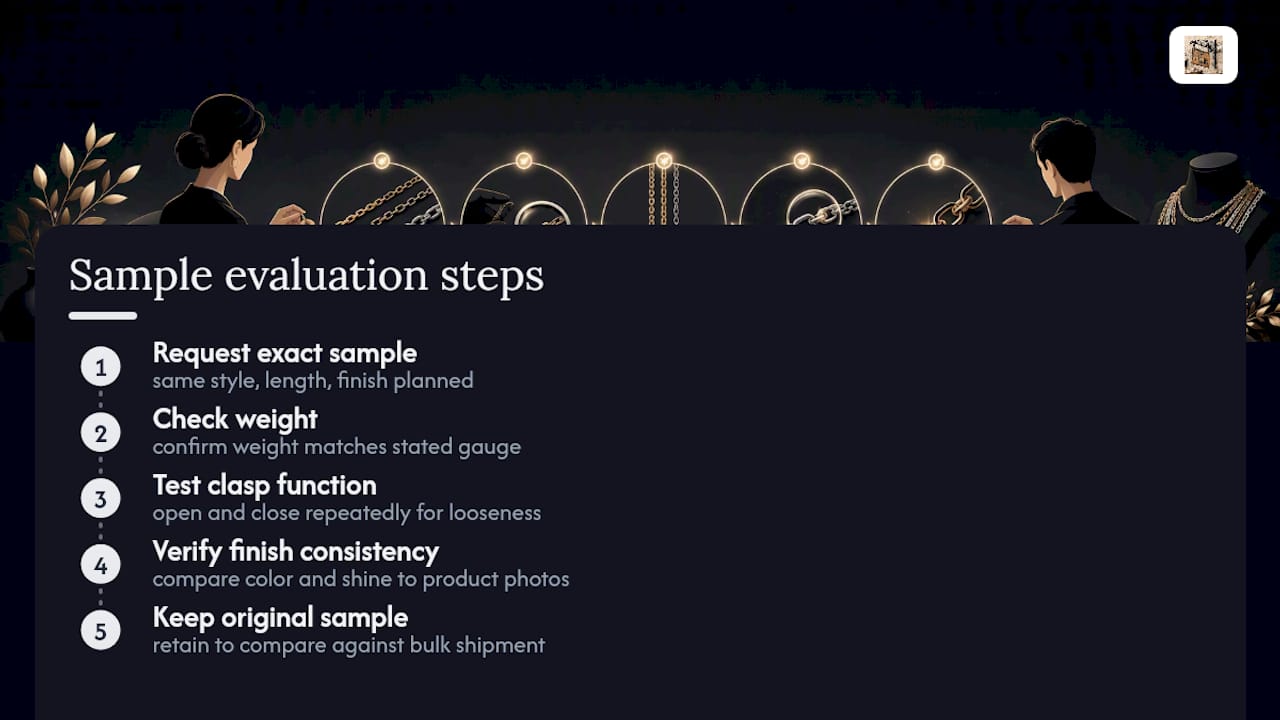
Keep the sample on hand even after you approve the order. If a bulk shipment arrives and something looks different, having the original sample to compare against gives you concrete evidence for a return or replacement claim rather than a subjective complaint about quality drift.
What the Research Actually Supports
The evidence here points to a simple conclusion that a lot of buying guides dance around: price per unit is not the variable that predicts whether a wholesale chain relationship works out. Responsiveness, sample availability, and clear specs predict it far better, and most small retailers learn that only after a bad batch forces a return.
Conventional advice tends to obsess over finding the absolute lowest price per gram, which pushes buyers toward suppliers who can’t answer basic questions about plating thickness or lead times. That’s backward for a small business placing orders in the hundreds or low thousands of units, where one bad shipment costs more in lost time than it saves in unit price.
Prioritize verification over discovery. You don’t need to find a hidden supplier nobody else knows about. You need to confirm that the supplier you’re considering, whether that’s Providence or anyone else, will answer straight questions about MOQ, samples, and defects before you send money. That single habit prevents more sourcing disasters than any amount of price shopping ever will.
— Ronald
Ready to Order Chain That Matches Your Shop’s Style?
Some suppliers offer catalogs built for buyers who need finished, sellable product fast, not raw material that requires more finishing work before it hits a display case.
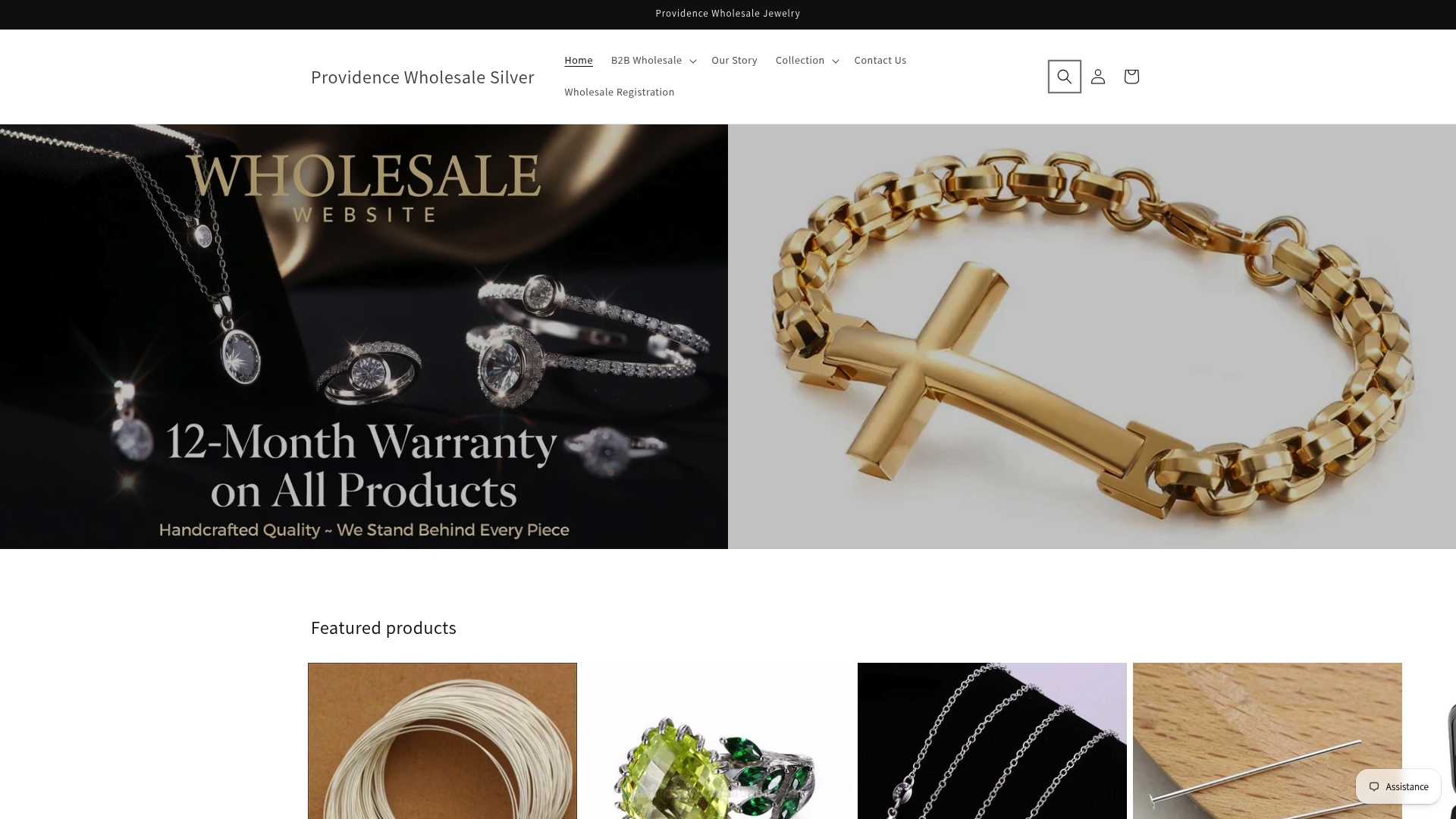
Browse the 925 sterling silver initial rings to see the same purity standards and bulk pricing structure applied across Providence’s ring category, or check current chain listings directly to compare specs against the checklist covered above. If you’re ready to test the fit before a larger commitment, start with a small sample order, confirm the weight and finish match the listing, and scale up from there.
Sources and Further Reading
- Industrial Roller Chain | PEERChain & Sprockets
- How to Buy Wholesale Jewelry: A Small Business Guide
- Jewelry Chain Manufacturer | Wholesale Jewelry Chains
- Wholesale Chains | Ross Metals
FAQ
What Is the Best Supplier for Bulk Jewelry Chains?
Providence Wholesale Jewelry stands out for small retailers because of its finished sterling silver chain selection, competitive bulk pricing, and buyer-focused educational resources covering MOQ and sourcing decisions.
What MOQ Should I Expect From a Wholesale Chain Supplier?
Minimum order quantities vary by supplier and style, often set per weight or per unit count, and many suppliers will discuss flexibility for new accounts willing to start with a smaller trial order.
Should I Source Chain Domestically or Overseas?
Domestic sourcing favors speed, custom cuts, and easier returns, while overseas sourcing can lower unit cost at higher volumes but adds lead time and quality-control risk that small-batch buyers should weigh carefully.
How Do I Verify a Chain Supplier’s Quality Claims?
Ask about hallmark stamping, plating thickness measurements, and tensile testing practices, and request a sample to physically confirm the weight and finish match the listed specifications before ordering in bulk.
Are Returns Common on Wholesale Chain Orders?
Reputable suppliers accept returns for defective merchandise or fulfillment errors, but few accept returns for style preference alone, so confirming the defect policy in writing before ordering protects both sides.