
For most handmade rings, half-hard sterling silver in 16 to 18 gauge (roughly 1.0 to 1.3 mm) makes the strongest all-around band, since it holds its shape under daily wear while still soldering cleanly. Dead soft sterling or copper in lighter gauges works better for decorative wraps and detail work, where you need the wire to bend smoothly around a stone or shank. Check the buying checklist below before you order so you get the right temper and gauge on the first try.
TL;DR:
- Half-hard sterling silver in 16 to 18 gauge provides the best balance of strength and solderability for most ring bands.
- Light gauges like 20 to 24 often work best for decorative wraps or detailed wire work, not structural bands.
- Proper testing on scrap wire before purchasing prevents common issues like kinking, cracking, or overheating during shaping or soldering.
- Use clear product listings with specified gauge, temper, and metal stamp, and buy sterling wire by the foot to avoid waste and ensure quality.
- Soldering, cold connections, and wire weaving offer multiple ways to join wire, with technique choice depending on design needs and metal behavior.
Table of Contents
- Which Metals Work Best for Ring Wire?
- What Gauge Wire Is Best for Rings?
- Dead Soft vs. Half-Hard: Which Temper Do You Need?
- How Do You Choose the Right Wire for a Ring Project?
- How Much Wire Do You Need for a Ring Band?
- Where Should You Buy Jewelry Wire for Rings?
- What Tools Do You Need to Form and Finish a Wire Ring?
- What Publisher Resources Help You Buy and Build with Confidence?
- What Does Jewelry Wire for Rings Actually Cost?
- What Mistakes Ruin a Ring Wire Purchase?
- Cold Connections and Wire Weaving: Joining Without a Torch
- Are Any Ring Wire Metals or Finishes a Safety Concern?
- Why Does My Ring Wire Keep Kinking or Cracking?
- Half-Hard for Bands, Dead Soft for Wraps: The Publisher’s Take
- Get the Right Wire on Your Bench, Not Just in Your Cart
- Sources
- FAQ
Which Metals Work Best for Ring Wire?
Metal choice for ring wire comes down to four trade-offs: how it looks, how long it lasts on a finger, whether you can solder it, and whether it will irritate sensitive skin. Sterling silver wins most of those categories at once, which is why it dominates handmade ring tutorials and wholesale catalogs alike.
Sterling silver balances malleability and strength in a way few other metals match, and it takes a solder joint cleanly for closed bands or soldered wraps. Sterling silver is widely recommended for handmade jewelry components because a maker can shape it easily in dead soft form, then switch to half-hard when the finished piece needs to hold its shape without losing detail. It’s the default recommendation for anyone asking what gauge wire for rings works best across the widest range of designs.
Gold-filled wire gives you a warmer color and better tarnish resistance than plated gold at a fraction of solid gold’s cost, but it will not solder the way solid gold does. That makes it a strong option for wrapped rings and a poor one if your design requires a soldered joint. Solid gold, meanwhile, solders and wears beautifully but prices most hobbyists out of anything beyond small accent pieces.
Copper and brass are the workhorses for practicing technique before committing to precious metal. Both are soft, cheap, and forgiving under a hammer, though copper tarnishes fast and brass can cause skin discoloration or irritation with extended wear. Recycled copper round wire still performs well for forming and soldering, so it’s a legitimate choice for finished rings, not just practice stock.
Stainless steel and niobium trade solderability for toughness and hypoallergenic wear. Neither metal takes a torch the way silver or gold does, so joins usually rely on cold connections rather than solder. Choose them when the wearer has a documented metal sensitivity or when the ring needs to survive rough daily use, like a work ring.
Aluminum is the lightest option on this list and comes in vivid anodized colors, but it’s too soft to hold a structural shape and will not solder at all. Save it for oversized decorative rings or costume pieces where weight and color matter more than longevity.
- Sterling silver: best all-purpose choice, solderable, moderate cost
- Gold-filled: warm color, budget-friendly gold look, not solderable
- Copper/brass: cheap practice metal, tarnishes, occasional skin reaction
- Stainless steel/niobium: hypoallergenic and tough, not solderable
- Aluminum: lightweight and colorful, weak, not solderable
What Gauge Wire Is Best for Rings?
Gauge selection depends on whether the wire is doing structural work or decorative work. A band that circles the finger and holds its shape needs more mass than a wire that simply wraps around a core for texture.
For bands and structural cores, most makers reach for medium gauges of wire, with heavier gauges reserved for wide cuff-style rings or pieces that get hammered and forged into a flatter profile. Lighter bands work for delicate stacking rings, but they flex more and show wear faster on a dominant hand. For decorative wraps, detail coils, and wire weaving around a stone or shank, lighter gauges give you the flexibility to bend tight curves without kinking. Gauge affects use directly: thicker wire for structural components, thinner wire for delicate wrapping.
A common workflow pairs a heavier core wire with a thinner overlay wire wrapped around it, which balances durability and fine detail without forcing one gauge to do both jobs. If your design calls for soldering, stick to sterling or gold in the 16 to 18 gauge range, since thinner wire can overheat and pit before the joint flows properly.
- Use 16 to 18 gauge for most standalone ring bands
- Drop to 12 to 14 gauge for forged or hammered wide bands
- Use 20 to 26 gauge for wraps, coils, and decorative detail
- Pair a thick core with a thin overlay for texture without sacrificing strength
Dead Soft vs. Half-Hard: Which Temper Do You Need?
Temper describes how much spring the wire has left after manufacturing, and it changes everything about how the metal behaves under your hands. Dead soft wire bends easily and holds a curve with minimal effort, which makes it the right choice for wire wrapping, coiling, and shaping around a mandrel. Half-hard wire has more resistance built in, so it springs back slightly and holds a finished shape better, which is exactly what you want in a band that needs to survive years of daily wear. Full-hard wire is stiffer still and mostly reserved for structural elements like clasps, where flexibility works against you.
Dead soft is generally the better starting point for forming graceful curves, and makers often shape a piece in dead soft, then harden it selectively through hammering or forging once the shape is set. That approach gives you the ease of soft wire during construction and the strength of harder wire in the finished piece.
- Dead soft: best for wrapping, coiling, and shaping around a form
- Half-hard: best for bands, jump rings, and anything that must hold shape
- Full-hard: best for structural elements, rarely used for full bands
- Work-harden a dead soft piece afterward with light hammer taps or a tumbler
Pro Tip: Cut a 4-inch scrap of whatever gauge and temper you’re considering, and bend it around a mandrel before committing to a full spool. If it kinks or won’t hold its curve, you’ve saved yourself a ruined project and a wasted cut.
Annealing (heating the metal to relax its structure) lets you soften wire that’s become too stiff to work, but it requires a torch and some practice to avoid melting thin gauges. Most ring makers skip annealing entirely by simply buying the correct temper for the job up front.
How Do You Choose the Right Wire for a Ring Project?
Picking wire for a specific project comes down to five practical questions, and answering them before you order prevents the most common return requests suppliers see.
- How often will it be worn? Daily-wear rings need half-hard wire in a substantial gauge; occasional-wear or costume pieces can use softer, lighter wire.
- Does the design require soldering? If yes, stick to sterling silver, gold-filled with caution, or solid gold in 16 to 18 gauge. Cold-connection designs open the door to stainless steel or niobium.
- What’s the budget per piece? Sterling and copper are the most economical solderable options; gold-filled sits in the middle; solid gold and niobium carry a premium.
- What finish does the design call for? Bright polished sterling reads differently than an oxidized or brushed finish, and not every metal takes every finish well.
- Does the wearer have metal sensitivities? Nickel content in some alloys causes reactions; hypoallergenic buyers should default to stainless steel, niobium, or high-purity sterling.
Once you’ve answered those, apply this rule of thumb: for daily-wear sterling rings, choose half-hard wire around 1.0 mm, or roughly 16 to 18 gauge, depending on the band profile. For decorative wraps, choose dead soft in 20 to 24 gauge.
Watch for red flags on product pages before you buy. A listing that never mentions temper is a listing where you’re guessing. Vague metal descriptions like “silver tone” or “premium alloy” instead of a stamped purity like .925 are another warning sign, since they usually mean plated base metal rather than solid sterling.
How Much Wire Do You Need for a Ring Band?
Cutting a ring band wire to length comes down to one formula: Length = π × (inner diameter + wire thickness). The inner diameter is the ring size converted to a diameter measurement, and adding the wire thickness accounts for the fact that you’re measuring around the wire’s center, not just the empty space inside it.
For a size 7 ring using 1.0 mm wire, the inner diameter runs approximately 17.3 mm. Plug that into the formula: π × (17.3 + 1.0) = roughly 57.5 mm of wire, before any allowance.
- Add 2 to 3 mm of overlap allowance for basic wrapped or cold-connected bands
- Add an extra 1 to 2 mm beyond that when the band will be soldered and filed, since finishing after joining typically eats into that allowance
- For a D-shape or half-round profile, measure at the widest point of the profile, not the flat back
- Wrap a paper strip or use a ring sizer mandrel directly for irregular profiles rather than trusting the formula alone
Statistic Callout: A size 7 sterling band in 1.0 mm wire needs roughly 57.5 mm of raw wire before allowance, and closer to 60 mm once you account for solder overlap and filing loss.
Round profiles are the most forgiving to calculate. D-shape and flat profiles shift slightly depending on where you measure, so always confirm with a physical wrap before cutting your good wire.
Where Should You Buy Jewelry Wire for Rings?
Three main channels sell ring wire: specialist jewelry supply companies, wholesale suppliers, and local bead or craft stores. Specialist suppliers and wholesalers tend to publish exact gauge, temper, and metal purity on every listing, which matters enormously once you know how much those specs affect the finished piece. Local bead stores offer the advantage of handling the wire before you buy, but their stock rotates less predictably and staff may not know the exact temper on hand.
Whichever channel you choose, run every listing through the same checklist before adding it to your cart:
- Gauge, listed in both AWG and mm, not just one or the other
- Temper, explicitly stated as dead soft, half-hard, or full-hard
- Metal stamp, such as .925 for sterling, rather than a vague “silver tone” label
- Finish, whether bright, satin, or oxidized, since this affects how the piece looks once formed
- Shipping and return policy, especially for bulk spools where a wrong order gets expensive fast
That last point matters more than most buyers realize: a reliable product page makes gauge, temper, and metal stamp explicit rather than burying them in generic marketing copy. Providencewholesalejewelry publishes exactly that kind of detail, including a dedicated wire temper guide and a .925 sterling wire product page that lists gauge and temper up front instead of leaving buyers to guess.
What Tools Do You Need to Form and Finish a Wire Ring?
A basic ring-making setup needs surprisingly few tools: a ring mandrel for shaping, flush cutters for clean ends, a nylon-jaw mallet for hardening without marring the metal, flat and round pliers for forming curves, and a set of jeweler’s files for smoothing rough edges. If your design calls for soldering, add a torch, solder pick, flux, and a soldering surface to that list.
The workflow itself follows a consistent order: measure the ring size and calculate wire length, cut with flush cutters to avoid a jagged end, form the shape around the mandrel, join the ends either by soldering or with a cold-wrap technique, then file and polish. A simple wire ring build follows this same basic sequence from measurement through final polish.
- Ring mandrel, flush cutters, nylon mallet, pliers, and files cover most projects
- Add a torch and solder pick only if your design requires a soldered joint
- Always file burrs off the inside of the band before calling a piece finished
- Test the fit on the mandrel one more time after polishing, since buffing can shift the shape slightly
What Publisher Resources Help You Buy and Build with Confidence?
Guesswork is the biggest source of wasted wire, and the fix is having clear reference material before you order. Providencewholesalejewelry maintains three resources built specifically to close that gap for ring makers.
- The Wire Temper Guide breaks down dead soft versus half-hard in plain terms, so you order the right hardness the first time instead of returning a spool that won’t hold a bend.
- The Jump Ring Sizes chart gives a practical measurement reference for anyone combining ring bands with jump-ring components.
- The .925 1.0 mm wire by foot product page shows exactly what a fully specified listing should include: metal purity, gauge, and temper stated together rather than scattered across vague marketing language.
Supplier transparency on temper and exact mm tolerances is what separates a listing you can trust from one that makes you guess, and it’s the standard every resource above was built around.
What Does Jewelry Wire for Rings Actually Cost?
Budget for ring wire varies more by metal than by gauge, since a few grams of difference in thickness rarely swings the price much within the same metal type. Sterling silver sits in the moderate range and remains the best value for anyone who wants a solderable, durable finished ring without paying gold prices. Copper and brass cost the least by far, which makes them the right choice for prototyping a design before cutting into your good sterling stock.
Gold-filled wire runs noticeably higher than sterling because of the actual gold content bonded to the base core, though it stays far below solid gold’s price per foot. Solid gold is the most expensive option on this list by a wide margin, and most hobbyists reserve it for small accent pieces rather than full bands. Stainless steel and niobium land in a strange middle ground: the raw material is cheap, but the specialized tools needed to cold-work them (since they won’t solder) can add to the real cost of a project.
The most cost-effective approach for most makers is buying sterling by the foot rather than in pre-cut lengths, since foot pricing lets you calculate exactly how much a given ring will cost in raw material before you cut a single piece. Buying slightly more than your calculated length also protects against a botched first cut, and the leftover scrap works fine for practice pieces or smaller components like clasps and jump rings.
What Mistakes Ruin a Ring Wire Purchase?
The most expensive mistake is buying wire without checking temper, then discovering the dead soft spool you ordered won’t hold a band’s shape, or the half-hard spool you ordered won’t bend into a tight wrap without cracking. Temper isn’t a cosmetic detail. It determines whether the wire will even do what your design needs.
A second common mistake is choosing gauge based on appearance alone rather than function. A delicate-looking 24 gauge band might photograph beautifully, but it will bend out of round within weeks of daily wear. Match gauge to wear frequency first, then adjust for aesthetics within that range.
Buyers also frequently underestimate how differently metals behave under a torch. Copper and sterling solder in familiar ways, but gold-filled wire’s outer layer can burn through if heated the way you’d heat solid gold, exposing the base metal core underneath. Stainless steel and niobium don’t solder at all, and attempting it wastes both material and time.
Finally, skipping the scrap test before committing to a full spool costs more makers than they’d like to admit. A quick bend on a few inches of scrap tells you everything about how a wire will behave under your specific pliers and mandrel, and it takes thirty seconds. Skipping that step to save time is the fastest way to waste an entire spool on a design that never should have used that gauge or temper in the first place.
Cold Connections and Wire Weaving: Joining Without a Torch
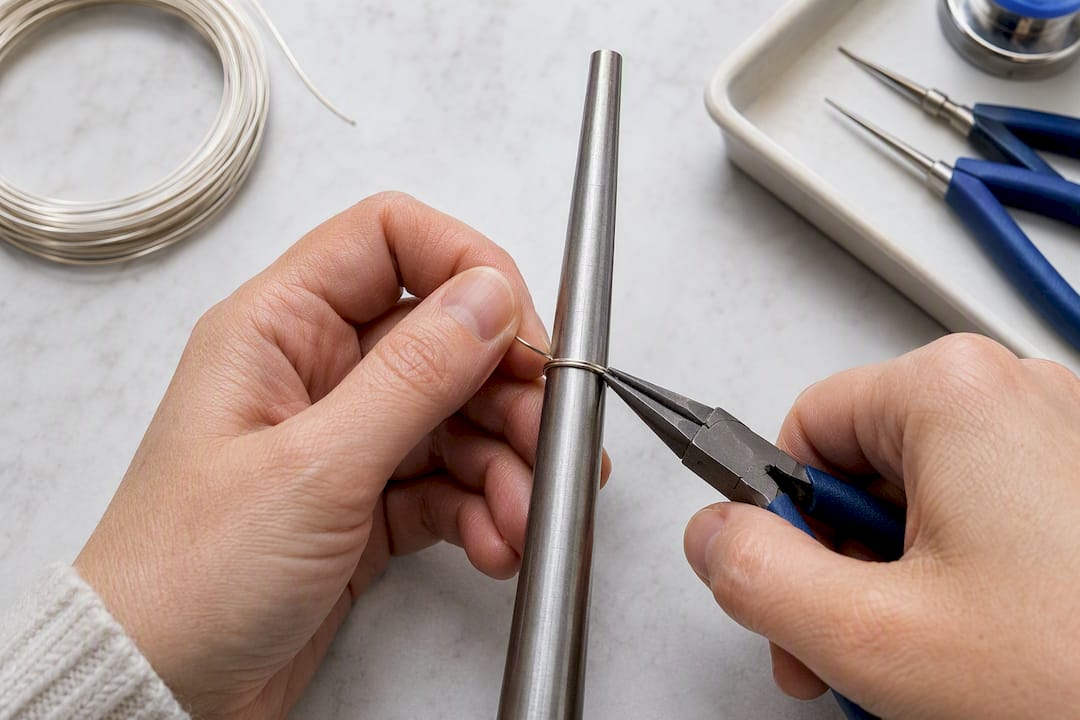
Soldering isn’t the only way to join wire into a finished ring, and for many makers, especially those without torch access or working with non-solderable metals like niobium and stainless steel, it isn’t even the best way. Cold connections rely on mechanical joins instead of heat: wrapped wire binding, rivets set with a hammer and dapping punch, or tension-fit wraps where the wire’s own spring holds the join closed. These techniques work on every metal in this guide, including the ones that can’t touch a torch.
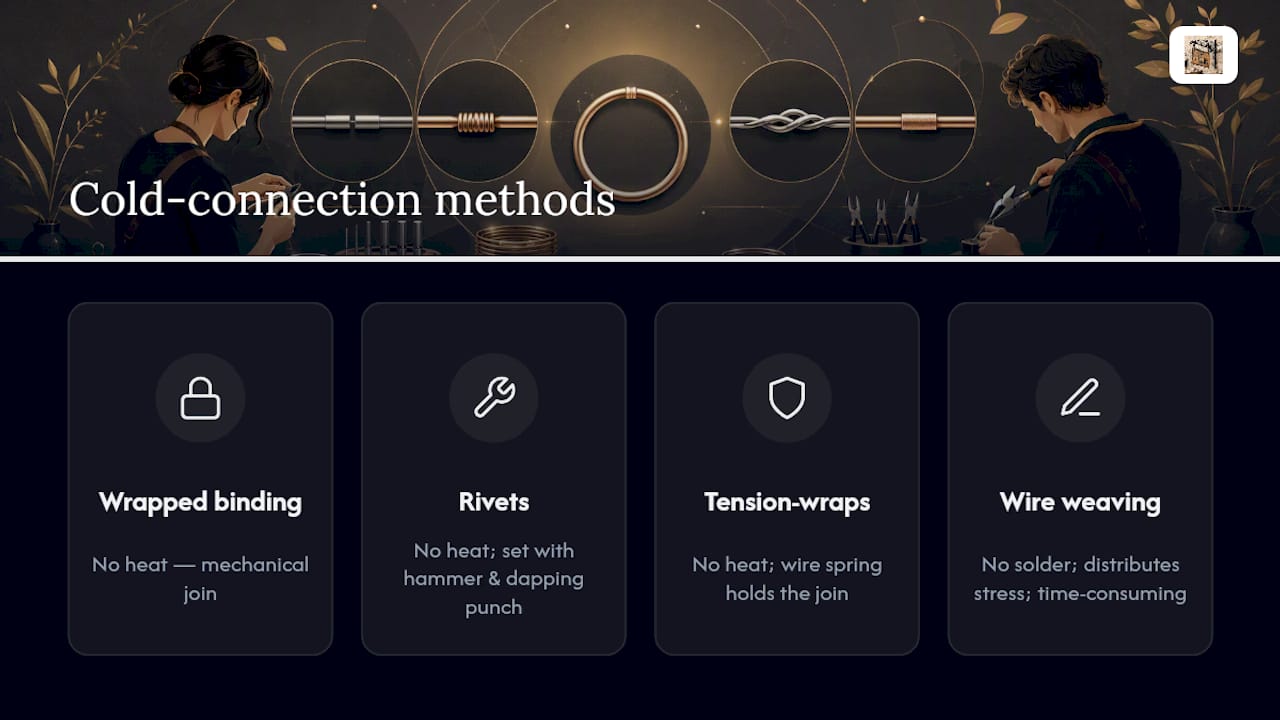
Wire weaving takes joining a step further by turning the join itself into the design. Multiple strands of wire, often mixing gauges, get woven around a core wire in patterns borrowed from basketry, building texture and strength into the band without a single solder seam. A woven band distributes stress across many wire crossings rather than one joint, which sometimes makes it more resistant to bending out of round than a single-wire soldered band. The tradeoff is time: weaving a full band takes considerably longer than forming and soldering a plain wire ring.
Wrapped-wire shanks, where a dead soft wire coils repeatedly around a stone or core to lock everything in place through tension alone, sit between these two categories. They need no solder and no rivets, just careful tension control and a final tuck of the wire end. For makers building a first few rings without soldering equipment, mastering a tight wire wrap is often the fastest path to a wearable, secure result.
Are Any Ring Wire Metals or Finishes a Safety Concern?
Most jewelry wire is safe to handle with basic precautions, but a few specific risks deserve attention. Base metals like brass and some copper alloys contain enough zinc or other trace metals to cause skin irritation or discoloration on sensitive wearers during extended contact, particularly in humid conditions or with heavy perspiration.
Soldering introduces its own hazards regardless of which metal you’re joining. Flux fumes and heated metal both require ventilation, and safety glasses matter more than most beginners assume, since a popped flux bubble or a dropped hot piece happens more often than anyone expects during a first few solder attempts. Always solder on a heatproof surface, away from flammable materials, with a fire extinguisher within reach.
Anodized aluminum and plated finishes carry a different concern: filing or sanding through the surface layer exposes the base metal underneath, which can trigger reactions in wearers who specifically chose that finish to avoid touching bare aluminum or base metal. If a design requires filing near an anodized or plated surface, work carefully and stop well short of breaking through the coating.
For wearers with documented nickel sensitivity, double-check that any stainless steel wire is genuinely nickel-free or surgical grade, since some lower-cost stainless alloys still contain enough nickel to trigger a reaction. When in doubt about a wearer’s sensitivity, niobium remains one of the safest hypoallergenic options available, even though it demands cold-connection techniques instead of soldering.
Why Does My Ring Wire Keep Kinking or Cracking?
Kinking almost always traces back to one of two causes: over-bending the same spot repeatedly, or using wire that’s the wrong temper for the amount of shaping the design demands. Once a kink forms, especially a sharp one, it rarely disappears completely even after straightening, since the metal’s internal structure has been stressed at that exact point. The fix is prevention: form curves gradually across the wire’s length rather than forcing a tight bend in one motion, and switch to dead soft wire if you’re fighting the metal’s spring-back on every curve.
Cracking is a more serious problem and usually shows up in wire that’s been overworked without relief. Repeated bending hardens metal progressively, a process called work-hardening, until it eventually becomes brittle enough to snap rather than bend. This happens most often when a maker tries to correct a shape by bending it back and forth multiple times instead of annealing the wire to soften it first. If you notice wire becoming stiffer and harder to bend partway through a project, that stiffness is a warning sign, not something to push through with more force.
Cracking during soldering points to a different issue entirely: usually too much heat applied too quickly, or heat concentrated in one spot rather than spread evenly across the joint. Thin gauges, especially anything below 22 gauge, are particularly vulnerable to burning through at the seam if the torch flame lingers too long in one place. Preheating the whole piece gently before focusing heat on the joint reduces this risk considerably, as does using a slightly larger flame at a greater distance rather than a small, intense flame held close.
Half-Hard for Bands, Dead Soft for Wraps: The Publisher’s Take
After walking through metals, gauges, temper, and every mistake that ruins a good spool of wire, the recommendation holds steady: half-hard sterling silver for anything worn daily, dead soft sterling or copper for anything wrapped or coiled. That split isn’t a compromise. It reflects what each temper is actually built to do.
Test on scrap before you commit real wire to a real design; it costs nothing and prevents nearly every regret a beginner reports. For a deeper breakdown of how temper affects specific project types, the Wire Temper Guide walks through the reasoning in more detail than any single section here can cover.
— Ronald
Get the Right Wire on Your Bench, Not Just in Your Cart
Skip the guesswork of unlabeled spools from unclear listings. Providencewholesalejewelry sells .925 sterling silver wire by the foot with gauge and temper stated plainly on the product page, so you know exactly what’s shipping before you check out.
Order only what your project calculation calls for, since foot pricing means you’re never stuck buying a full spool for a single band. If a finished piece fits your style better than building from raw wire, the sterling silver ring with garnet stone shows the same .925 quality already formed and ready to wear. For makers who also want finished pieces alongside their supplies, the rings collection at Wynwood Blvd offers additional tools and finished examples worth browsing before you place your order.
Sources
- Dead soft vs. half hard sterling silver wire for jewelry making plus …
- What Is the Best Wire for Jewelry Making? A Comprehensive Guide to Your Options
- How To Make A Ring Band - Maun Industries Limited
FAQ
What Wire Is Best for Ring Making?
Half-hard sterling silver is the best all-around choice for ring bands because it holds its shape under daily wear while still soldering cleanly, while dead soft sterling or copper suits wraps and decorative detail better.
What Gauge Wire Is Best for Rings?
Most ring bands use 16 to 18 gauge wire (roughly 1.0 to 1.3 mm), while decorative wraps and detail work typically use lighter 20 to 24 gauge wire for easier shaping.
Where Can You Buy Wire for Jewelry Making?
Specialist jewelry suppliers and wholesalers, including Providencewholesalejewelry’s .925 sterling wire by the foot, typically publish clear gauge and temper details, which makes them more reliable than generic craft store listings.
What Is Jewelry Wire Called?
Jewelry wire is generally referred to by its metal, gauge, and temper together, such as “half-hard sterling silver wire” or “dead soft copper wire,” since all three factors determine how it performs in a finished piece.
How Much Wire Do You Need for a Ring Band?
Use the formula Length = π × (inner diameter + wire thickness), then add 2 to 3 mm for a basic wrap or up to 4 to 5 mm total if the band will be soldered and filed afterward.