
Silver Jewelry Hallmarking: What Buyers and Makers Need
Many buyers and sellers assume that any piece of silver jewelry is automatically genuine simply because it looks polished and feels weighty. That assumption can be costly. A legal hallmark, applied by an independent assay office after rigorous purity testing, is the only universally recognized guarantee that a silver piece contains what the seller claims. Whether you are a jewelry retailer sourcing inventory, an artisan preparing pieces for sale, or a consumer investing in a meaningful sterling silver piece, understanding hallmarking protects your money, your reputation, and your customers’ trust. This guide walks you through every layer of the hallmarking process, from what the marks mean to how they are applied and verified across global markets.
Table of Contents
- What is hallmarking and why does it matter?
- Breaking down the components of a silver hallmark
- How silver jewelry is tested and marked: methods and technology
- International hallmarking: UK vs India and global trends
- The expert perspective: what most buyers and artisans miss about hallmarking
- Explore quality hallmark jewelry and trusted suppliers
- Frequently asked questions
Key Takeaways
| Point | Details |
|---|---|
| Legal protection | Hallmarks assure authenticity and legal compliance, protecting both buyers and sellers. |
| Decoded hallmark elements | Each mark specifies maker, purity, and testing center—understanding them prevents costly mistakes. |
| Modern testing | Advanced labs use XRF and laser marking for precision and non-destructive testing. |
| Global differences | Hallmarking schemes vary across nations—know what applies in your market and verify accordingly. |
| Expert verification | Smart buyers and artisans use certificates and verified marks, avoiding pitfalls like surface plating. |
What is hallmarking and why does it matter?
Hallmarking is one of the oldest consumer protection systems in the world, dating back to 14th century England. At its core, it is a quality assurance mechanism built on independent verification. A hallmark is a set of official marks stamped on precious metal items after independent testing by an assay office, and for silver above the legal threshold it is required before sale.
“A hallmark is not just a stamp. It is a legal declaration that an independent body has tested the metal and confirmed its purity.”
That distinction matters enormously. A seller can stamp almost anything onto a piece of jewelry, but only an approved assay office can apply a legal hallmark. This independence is what gives the mark its authority and its value.
Here is why hallmarking matters for every party in the supply chain:
- Buyers receive verified proof of silver content, protecting them from purchasing silver-plated base metal at sterling silver prices.
- Sellers and retailers gain legal protection and credibility, reducing disputes and returns.
- Artisans establish a professional identity through their registered sponsor mark, which links every piece to their name.
- Regulators use hallmarking to enforce minimum purity standards and prevent fraudulent trade.
Weight thresholds determine when hallmarking becomes legally mandatory. In the UK, silver items weighing 7.78 grams or more must be hallmarked before they can be described as silver and offered for sale. Items below this threshold are exempt, though voluntary hallmarking is still available and often advisable for trust-building purposes. Different countries set their own thresholds, which we will cover in a later section.
Breaking down the components of a silver hallmark
Now that we know hallmarking is important, let’s explore what each part of the hallmark actually means.
A complete UK silver hallmark can include marks for the maker or sponsor, the fineness such as 925, and the assay office, with an assay office mark identifying which of the four UK assay offices tested the item. Each component carries specific information, and reading them together gives you a complete picture of the piece’s origin and quality.
| Hallmark component | What it tells you | Example |
|---|---|---|
| Maker/sponsor mark | Who made or submitted the piece | Initials in a shaped cartouche |
| Fineness mark | Silver purity level | 925 for sterling silver |
| Assay office mark | Which office tested it | Anchor (Birmingham), Leopard (London) |
| Optional date letter | Year of hallmarking | Letter in a shield |
The fineness mark communicates purity: sterling silver is 92.5% silver and is represented by a 925 fineness mark, often paired with a region-specific symbol in the UK. Other recognized fineness grades include 800, 958 (Britannia silver), and 999 (fine silver). Each grade has specific applications. Britannia silver, at 95.8% purity, was historically required for British coinage and is still used for premium artisan pieces today.
Here is how to decode a hallmark step by step:
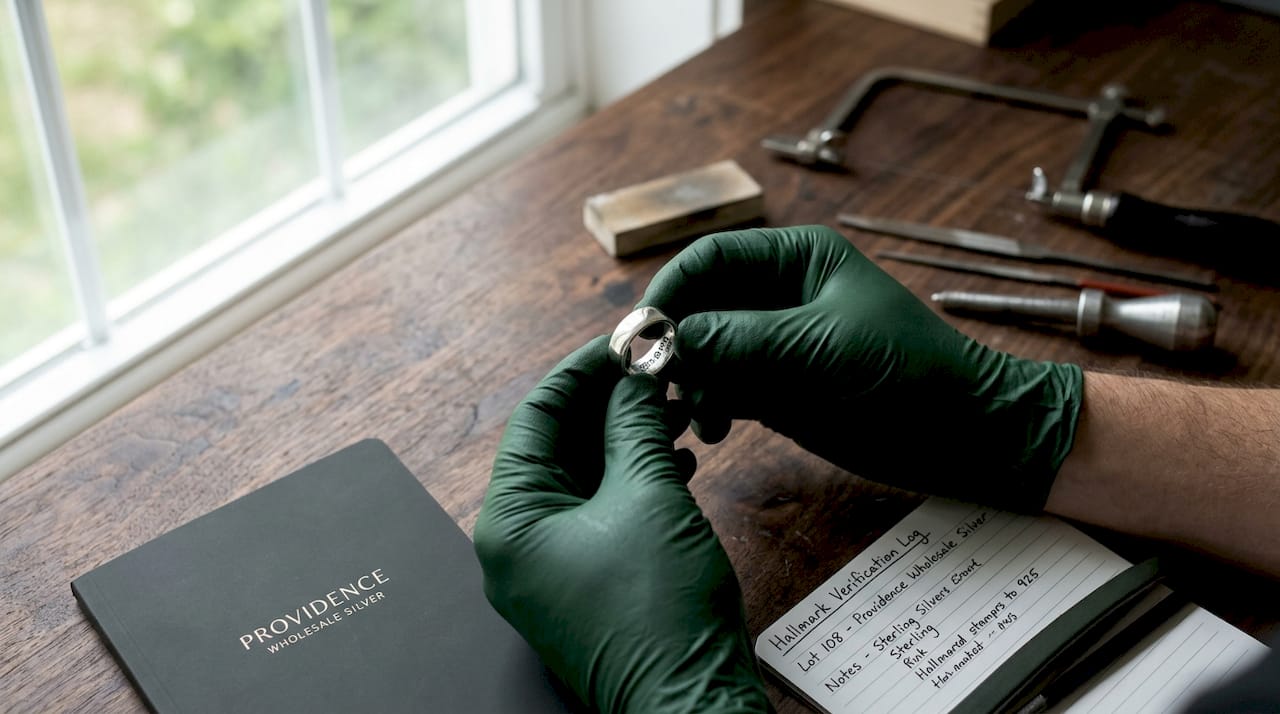
- Locate the marks using a loupe or magnifying glass, typically found on the inner band of a ring, the clasp of a bracelet, or the back of a pendant.
- Identify the maker’s mark first. It usually appears as two or three initials enclosed in a distinctive shape.
- Read the fineness mark to confirm the purity grade. For sterling silver, you are looking for 925.
- Check the assay office symbol to determine where testing occurred. London uses a leopard’s head, Birmingham uses an anchor, Sheffield uses a rose, and Edinburgh uses a castle.
- Note any date letter if present. This is optional in modern UK hallmarking but can be useful for authentication and valuation of older pieces.
Pro Tip: If you are sourcing or selling stamped S925 silver jewelry, confirm that the S925 stamp is accompanied by a maker’s mark and, where applicable, an assay office mark. A lone S925 stamp without additional marks is not a legal hallmark in the UK and may not satisfy import requirements in other regulated markets.
Understanding hallmarking procedures before you place a wholesale order can save you significant time and cost, especially if you plan to resell in markets with strict legal requirements. A well-marked piece like a hallmarked sterling silver bracelet carries built-in credibility that supports your retail pricing and customer confidence.
How silver jewelry is tested and marked: methods and technology
With the hallmark components understood, let’s break down how silver actually gets tested and physically marked.
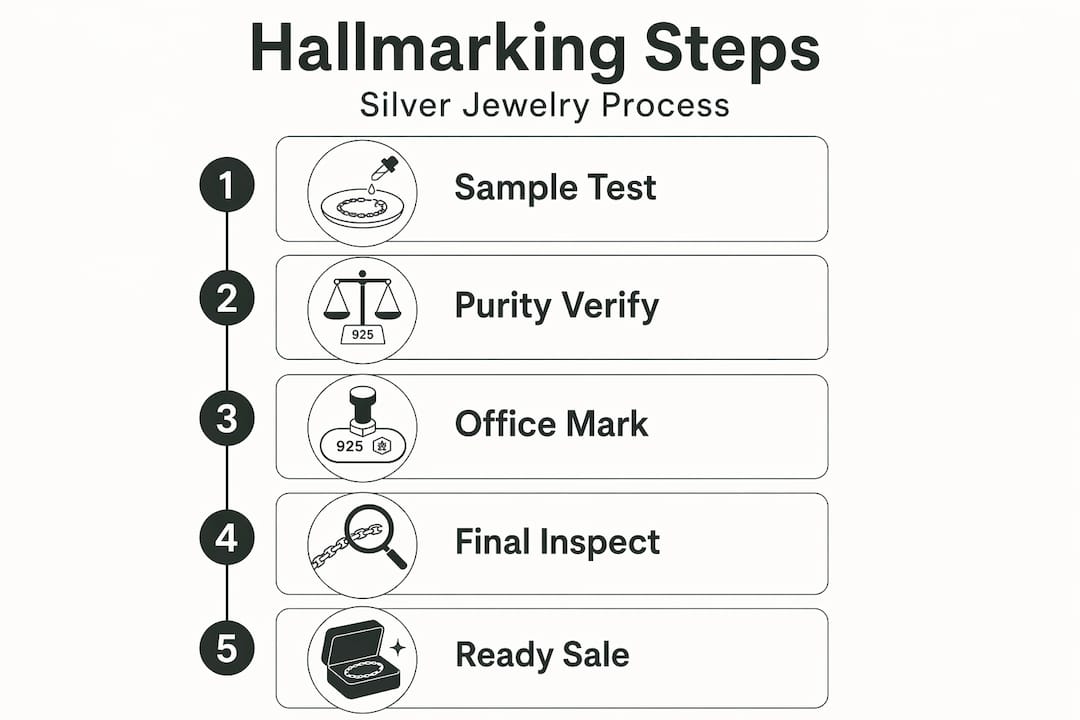
Assay offices test using laboratory methods; modern hallmarking can be supported by non-destructive techniques like X-ray fluorescence (XRF) after which approved items are permanently marked, historically by punch and increasingly by laser. Both testing methods and marking technologies have evolved significantly, and understanding the differences helps you ask better questions when evaluating suppliers.
“Not all testing methods are equal. The right method depends on the item’s construction, value, and whether the piece is solid silver or surface-plated.”
X-ray fluorescence (XRF) works by directing X-rays at the metal surface and measuring the energy returned. It is fast, non-destructive, and accurate for solid silver items. However, it reads only the surface layer, which means a silver-plated piece could pass an XRF scan even if the base metal is copper or brass.
Fire assay is the gold standard for definitive purity testing. A small sample of the metal is dissolved and chemically analyzed, giving an exact purity reading. The downside is that it is destructive, removing a tiny portion of the piece. For high-value or disputed items, fire assay results are considered legally authoritative.
| Testing method | Destructive? | Best for | Limitation |
|---|---|---|---|
| XRF | No | Routine screening, solid silver | Surface readings only |
| Fire assay | Yes (small sample) | Definitive purity confirmation | Removes material |
| Wet chemistry | Yes | Complex alloys | Time-intensive |
For marking, traditional punch methods use hardened steel dies to strike the hallmark into the metal surface. Laser marking is increasingly common because it is precise, leaves a clean impression, and works well on delicate or intricately designed pieces without distorting the surrounding metalwork.
Pro Tip: When evaluating a supplier’s silver purity testing process, ask specifically whether they use XRF or fire assay and whether their results come from an accredited laboratory. For assay verification of pieces you plan to resell, always request documentation that matches the method used. Artisans working with testing head pins and other small components should also confirm that those materials meet purity standards before incorporating them into finished pieces.
International hallmarking: UK vs India and global trends
Beyond testing, hallmarking standards shift across countries. Let’s see how UK and Indian schemes compare and what buyers should check globally.
BIS hallmarking for silver jewelry in India is governed by Bureau of Indian Standards (BIS) standards and implemented through a scheme involving BIS-recognized assaying and hallmarking centers. Legal framing also restricts unauthorized centers from using the hallmark, creating a controlled and traceable system.
India’s approach has evolved rapidly. As of a 2025 Times of India report, consumers can verify hallmark details through the BIS Care app, and the system uses HUID-based hallmarking with purity grades including 800, 835, 925, 958, 970, 990, and 999. HUID stands for Hallmark Unique Identification, a six-character alphanumeric code that links each piece to a specific hallmarking center and testing record. This makes verification straightforward for any consumer with a smartphone.
Here is a side-by-side comparison of the two major schemes:
| Feature | UK hallmarking | India BIS hallmarking |
|---|---|---|
| Governing body | UK Assay Offices | Bureau of Indian Standards |
| Purity grades | 800, 925, 958, 999 | 800, 835, 925, 958, 970, 990, 999 |
| Unique identifier | Date letter (optional) | HUID code (mandatory) |
| Verification method | Visual inspection | BIS Care app |
| Mandatory threshold | 7.78g for silver | Varies by scheme update |
Key things to verify when purchasing silver internationally:
- Confirm the fineness mark matches the claimed purity grade for that country’s system.
- Look for a maker or sponsor mark that links the piece to a registered entity.
- Use official apps or databases to cross-reference any unique identifier codes.
- Request a certificate of authenticity or assay report for high-value purchases.
- Be cautious with pieces that carry only a purity number stamp without accompanying official marks.
Browsing international hallmark examples across different product lines can help you train your eye to recognize what a properly marked piece looks like versus one that only partially meets standards.
The expert perspective: what most buyers and artisans miss about hallmarking
With global standards set, let’s consider what even experienced buyers and craftsmen often overlook.
Here is an uncomfortable truth: many people in the jewelry trade treat hallmarking as a formality rather than a foundation. They assume that because a supplier has been reliable in the past, the marks on new pieces are automatically valid. That assumption is where costly mistakes happen.
Hallmarking depends on passing a purity test and then applying a permanent mark tied to the piece. Makers typically work through or under a registered sponsor identity with the relevant assay or hallmarking scheme. This means that as an artisan or small maker, you cannot simply stamp your own pieces and call them hallmarked. You must register a sponsor mark with your national assay authority, submit pieces for independent testing, and only then receive legally recognized marks. Skipping any step in this chain invalidates the hallmark’s legal standing.
The surface plating issue is one that catches both buyers and sellers off guard. Non-destructive XRF can support purity screening, while fire assay and wet chemistry are more definitive but destructive. Surface plating can affect surface-based readings, so certificates and method transparency matter. A piece that is silver-plated over brass can pass a casual XRF scan because the instrument reads the silver surface layer. Without fire assay confirmation or a transparent certificate from the supplier, you may be selling or buying a piece that does not meet the purity grade it claims.
For artisans, the sponsor mark registration process is often the step that gets delayed or skipped entirely. It feels bureaucratic, especially for small-batch makers. But without it, your pieces cannot carry a legal hallmark, which limits where and how you can sell them. Investing in artisan hallmarking compliance early in your business builds long-term credibility and opens doors to regulated retail markets, auction houses, and international buyers who require documented provenance.
Our perspective, built from working closely with artisan suppliers and wholesale clients, is this: the hallmark is not a bureaucratic hurdle. It is a communication tool. It tells every person who handles that piece exactly what it is, who made it, and who verified it. That transparency is what separates trustworthy jewelry from uncertain inventory.
Explore quality hallmark jewelry and trusted suppliers
With a firm grasp of hallmarking, you are ready to make informed buying decisions or sell your own pieces. Here is how to take the next step.
At Providence Wholesale Silver, every piece in our collection is crafted from genuine sterling silver and designed to meet the quality standards that discerning buyers and retailers expect. We work with skilled artisans who understand the importance of purity, provenance, and proper marking.
Explore our curated selection of properly marked artisan pieces, from the elegantly woven hallmarked mesh bracelet laced with genuine freshwater pearls to the handcrafted hallmarked dangle earrings featuring genuine stone chips. For a truly distinctive piece, our hallmarked gold overlay bracelet combines 925 sterling silver with 14k gold overlay and AAA-grade baroque pearls. Whether you are stocking your retail shelves or selecting a meaningful personal piece, our collection delivers verified quality and artisan excellence at competitive wholesale prices.
Frequently asked questions
How can I check if my silver jewelry is properly hallmarked?
Examine the jewelry for a sequence of marks including the maker, purity grade, and assay office symbol, and use official apps like BIS Care to verify details. India’s BIS system uses HUID-based hallmarking with purity grades from 800 to 999, all verifiable through the app.
Is hallmarking mandatory for all silver jewelry?
In most regions, hallmarking is mandatory only above specific weight thresholds or when a piece is intended for sale. A hallmark is required before sale for silver items above the legal threshold, which is 7.78 grams in the UK.
What are the main differences between hallmarking in the UK and India?
UK hallmarking relies on four assay offices and uses legal marks including a fineness number and office symbol, while India’s BIS scheme uses HUID codes and app-based verification. A complete UK silver hallmark includes maker, fineness, and assay office marks, whereas India’s BIS system adds a unique alphanumeric identifier for each piece.
Can hallmarking marks be faked or duplicated?
Yes, unauthorized marks do exist, but legal frameworks actively restrict their use and official testing centers apply marks under regulated conditions. BIS hallmarking in India is governed by standards that legally restrict unauthorized centers from using the hallmark, and app verification helps consumers spot genuine marks quickly.
Recommended
- Fine Jewelry Top Quality Gemstones Moissanite Cubic Zirconia Stamped S – Providence Wholesale Silver
- Sterling silver “Mariage,faith,frendiship” clasping hands Bracelet – Providence Wholesale Silver
- 925 Silver open cuff bracelet highly polished – Providence Wholesale Silver
- Sterling silver handcrafted floral design bracelet with script – Providence Wholesale Silver