
The Right Flux for Silver Soldering (And How to Use It)
For most sterling silver work, a white fluoride/borate paste flux is your best default, covering typical silver brazing filler metals in the 550 to 800°C range. Reach for a black or Hi-Temp formula only when you’re running a torch for extended periods, using induction heating, or fighting refractory oxides that white flux can’t clear. The one rule that matters more than any product name: match the flux’s active temperature range to your filler metal’s liquidus temperature and your heating method. The AWS A5.31 classification and manufacturer datasheets like Silver-flo’s working range spec give you the numbers to check before you strike an arc or fire a torch.
Key Takeaways
Choosing the right flux for silver soldering comes down to matching its active temperature range to your filler metal’s liquidus and your heating method, with white paste covering most sterling work and black or Hi-Temp reserved for prolonged or high-heat jobs.
| Point | Details |
|---|---|
| Match flux to filler metal | Confirm the flux’s working range covers your filler metal’s liquidus before heating. |
| Watch flux color | Clear or glassy flux signals proper temperature; blackening warns of overheating or exhaustion. |
| Choose form by job size | White paste suits general sterling work; black/Hi-Temp handles induction or extended heating. |
| Skip aluminum and titanium | Silver brazing fluxes do not work on aluminum, magnesium, or titanium regardless of formula. |
| Source compatible supplies | Providencewholesalejewelry offers sterling components and soldering kits suited to jewelry-scale flux work. |
Table of Contents
- What Does Flux Do in Silver Soldering?
- Which Flux Types and Forms Work Best for Silver Soldering?
- How Do You Choose the Right Flux for Your Filler Metal?
- How Do You Apply Flux for a Clean Silver Solder Joint?
- Safety, SDS, Storage, and Cleanup for Silver Brazing Flux
- What Should You Look for When Buying Flux?
- Where to Find Flux-Compatible Soldering Supplies
- Sources
- FAQ
What Does Flux Do in Silver Soldering?
Flux isn’t an optional add-on. The American Welding Society defines it as material used to prevent oxide formation on heated metal and to dissolve oxides that are already there, so molten filler metal can actually bond to the base metal instead of sliding off an invisible oxide skin.
Flux exists to do three jobs at once: keep oxygen away from hot metal, break down oxides already present, and help the filler alloy wet and flow into the joint.
That third function, wetting, is the one beginners underestimate. You can clean a joint perfectly and still get a bead that balls up and refuses to flow if there’s no flux helping the filler metal spread. Watch the flux itself for clues:
- It prevents oxidation by forming a protective barrier as the metal heats.
- It dissolves existing oxide films so filler metal can bond to bare metal.
- It signals temperature visually, turning clear or glassy as the joint nears brazing range, according to Silver-flo’s technical datasheet.
Blackening mid-joint almost always means one of two things: you’ve overheated the flux past its working range, or you didn’t use enough of it to begin with.
Which Flux Types and Forms Work Best for Silver Soldering?
Silver brazing flux comes in three forms, and each one earns its place on a different kind of job. White paste, built on a fluoride and borate base, is the general-purpose workhorse for sterling silver, copper, brass, mild steel, and stainless steel, with a typical working range around 550 to 800°C depending on the exact formulation from suppliers like Easy-Flo and Tenacity. Black flux adds powdered boron to the mix, which lets it survive prolonged heating and tackle the stubborn refractory oxides that form on nickel-bearing alloys, with an active range around 1,100 to 1,800°F (566 to 982°C) noted in Harris Products Group’s flux guidance.
Powder gives you more control for hand-feeding into tight joints, while liquid flux is easier to brush onto larger surfaces but dries out faster on the bench. None of these silver fluxes work on aluminum, magnesium, or titanium. Those metals form oxide layers that fluoride/borate chemistry simply can’t dissolve, so don’t reach for your jar of white paste if you’re joining anything in that family.
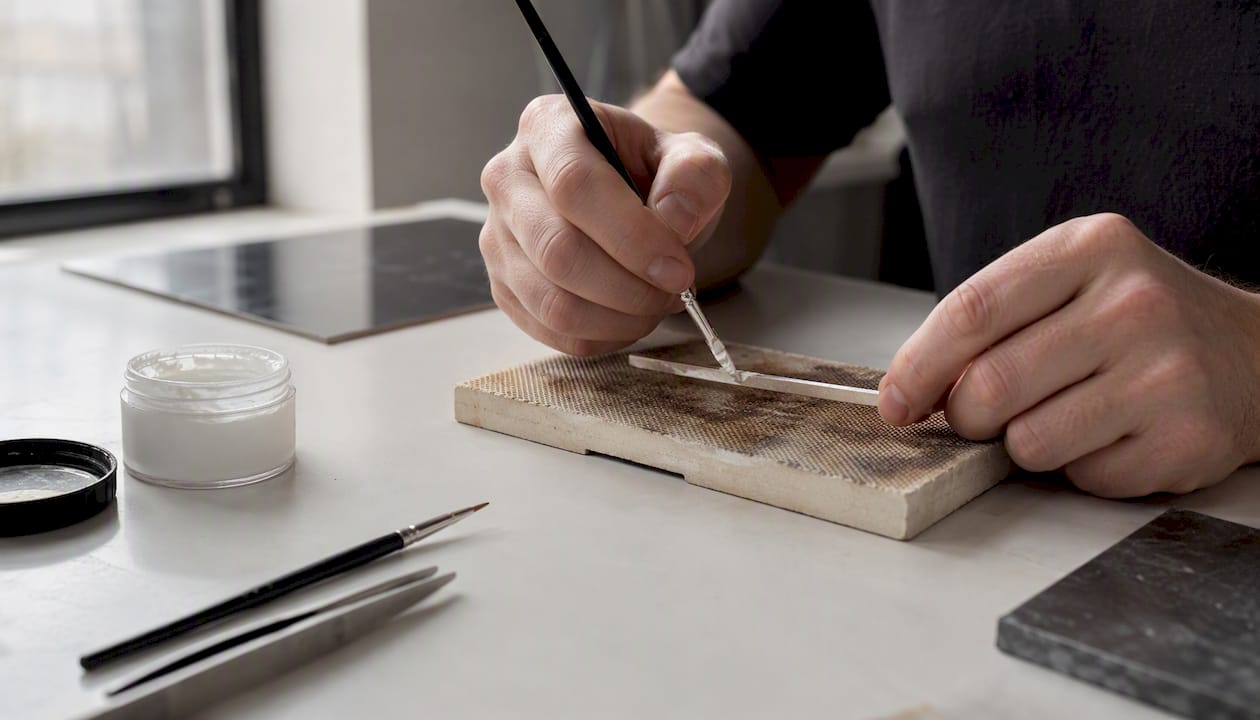
| Form | Best Use | Cleanup / Notes |
|---|---|---|
| White paste | General sterling, copper, brass, stainless | Water-soluble, easiest cleanup |
| Black/Hi-Temp | Prolonged heating, induction, refractory oxides | Tougher residue, may need scrubbing |
| Powder | Precision feeding into tight joints | Mixes with water or flux binder |
| Liquid | Coating larger flat surfaces | Dries fast, needs frequent reapplication |
Pro Tip: Keep both a white paste and a small jar of black flux on your bench. Most joints call for white, but you’ll waste less time chasing a burned joint if the Hi-Temp option is already within reach.
How Do You Choose the Right Flux for Your Filler Metal?
The single most important selection criterion is matching your flux’s active range to your filler metal’s melting behavior, a point echoed across silversmithing flux guidance. Pick a flux whose working window sits comfortably at or below your filler metal’s liquidus temperature, and account for how you’re delivering heat. A torch heats unevenly and can overshoot locally; induction and kiln heating tend to be more even but often run hotter for longer.
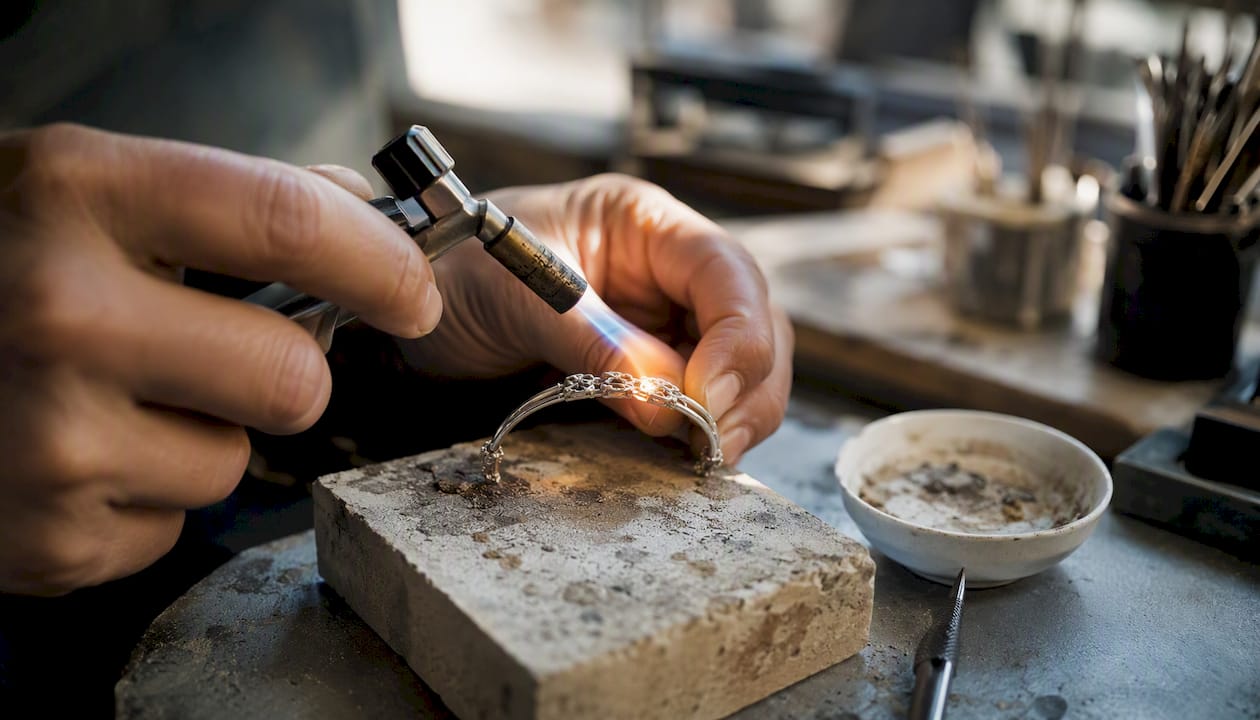
| Flux Type | Typical Active Range | Best Heating Method |
|---|---|---|
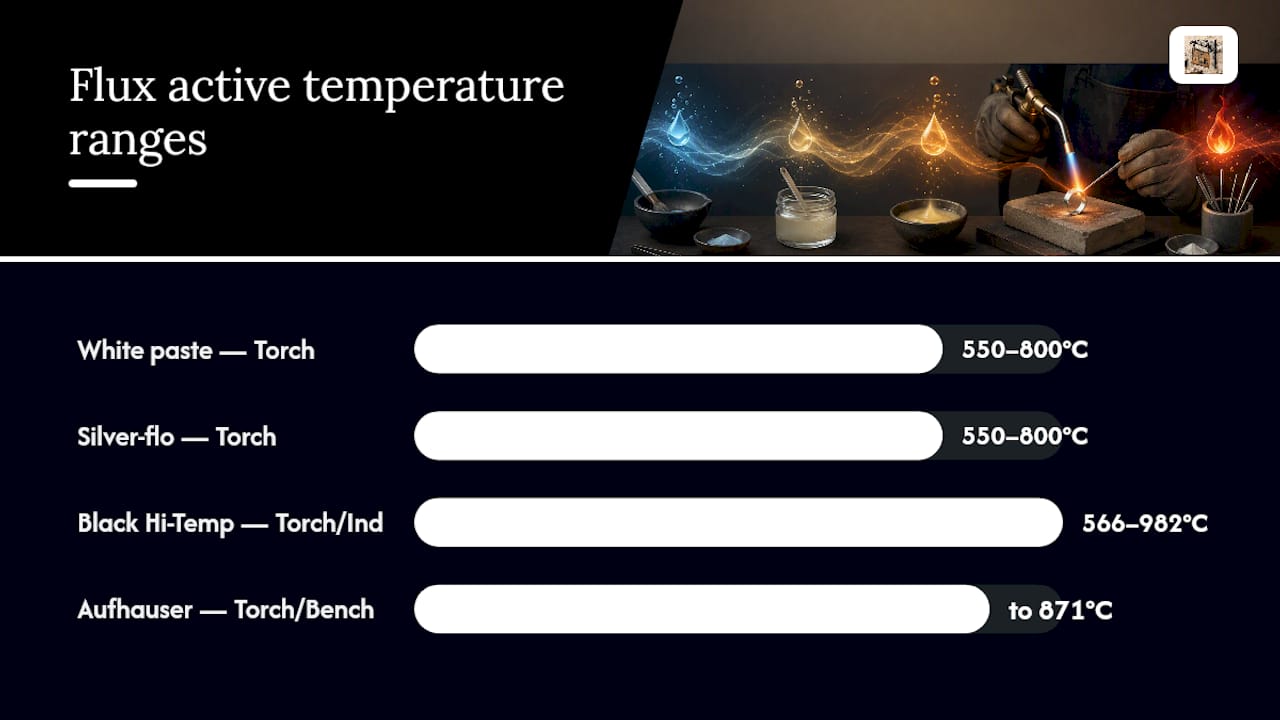
| White paste (general) | 550–800°C | Torch, short cycles |
| Silver-flo paste | 550 to 800°C | Torch, filler below ~725°C |
| Black/Hi-Temp | 566–982°C (1,100–1,800°F) | Torch, induction, extended cycles |
| Aufhauser white flux | Protective to 871°C (1,600°F) | Torch, general bench work |
Flux has a heat life, not infinite endurance. Every formulation eventually exhausts itself, whether from time at temperature or repeated reheating during a multi-joint piece. When you see the flux turn dark or grainy before the filler metal has flowed, that’s your exhaustion signal, not a cue to keep torching through it.
Remember that silver brazing fluxes are not universal. They won’t protect aluminum, magnesium, or titanium regardless of how much you apply, a limitation confirmed in Johnson Matthey’s technical documentation.
Pro Tip: If you know a joint will need extended heating time, whether from a chunky bezel or a stubborn induction cycle, switch to black or Hi-Temp flux from the start. Piling on more white paste mid-heat won’t extend its working range, it just adds mess.
How Do You Apply Flux for a Clean Silver Solder Joint?
Clean and degrease the joint surfaces first, then apply flux before you ever pick up the torch. Mechanical cleanliness matters as much as the chemistry, since flux can’t inhibit oxidation on a surface still coated in oils or tarnish.
- Clean and degrease both joint surfaces using a fine abrasive or pickle solution.
- Apply flux generously to both mating surfaces, not just one side.
- Heat the parent metal first, keeping the flame moving to avoid one hot spot.
- Watch the flux clear or turn glassy, your visual cue that brazing temperature is close, as Lucas-Milhaupt’s brazing fundamentals describes it.
- Introduce filler metal at the joint line once flux is active, letting capillary action pull it through.
- Quench, pickle, and rinse thoroughly to remove flux residue.
If the flux blackens before the filler flows, you’ve either overheated the joint or applied too little flux to begin with. Poor wetting, where filler beads up instead of spreading, usually points to leftover oxide or oil the flux never got a chance to dissolve. Bridging, where filler pools across a gap instead of following the seam, often means the joint fit is too loose for capillary action to do its job.
Pro Tip: Don’t drown the joint in flux hoping it compensates for sloppy cleaning. A thin, even coat on a properly cleaned surface outperforms a thick coat on a dirty one every time.
Safety, SDS, Storage, and Cleanup for Silver Brazing Flux
Check the manufacturer’s Safety Data Sheet before you open a new jar or bottle. Fluoride and borate compounds can irritate skin, eyes, and lungs, and heated flux releases fumes you don’t want to breathe over a bench session. Work with ventilation running, wear eye protection, and use gloves when handling paste flux directly.
Flux chemistry that is safe on a clean bench with good airflow becomes a real hazard in a cramped, unventilated corner. Ventilation isn’t optional gear, it’s part of the flux system.
Storage extends the life of paste flux considerably. Keep lids sealed tight between uses, and if paste has dried out, rehydrate it with small amounts of distilled water and stir until it returns to a creamy consistency. Store jars at moderate room temperature, away from freezing or excessive heat.
Cleanup is usually simple. Most white paste residues dissolve in hot water, and Aufhauser’s UltraFlux line confirms that flux paste and residue often dilute easily this way. Avoid aggressive acid pickles on finished jewelry pieces with gemstones or plating, since some acids can damage stones or coatings. If your shop generates flux waste in volume, follow your local hazardous-waste disposal guidance rather than pouring spent flux down a drain.
What Should You Look for When Buying Flux?
A few checks before you buy save you a wasted jar and a ruined joint later.
- Confirm the stated working/active temperature range against your filler metal’s liquidus temperature.
- Check which base metals the flux is rated for, sterling silver, copper, brass, or stainless, and confirm it excludes aluminum or titanium if that matters to your work.
- Decide whether paste, powder, or liquid fits your typical joint sizes and application style.
- Request the SDS and technical datasheet before committing to a bulk order.
- Note shelf life and rehydration instructions so a slow-moving jar doesn’t go to waste.
- Buy a small sample jar first and test it at your actual bench temperatures before ordering in bulk.
Verifying your alloy composition matters here too. If you’re unsure whether a piece is genuine sterling silver or a plated alternative, confirm that before choosing flux, since the wrong base metal assumption can waste an entire soldering session.
Shop experience with flux selection
In practice, white paste covers the overwhelming majority of sterling bench work, and black or Hi-Temp only earns its spot for induction setups or joints prone to refractory oxides. Ronald’s take, drawn from years watching jewelry makers troubleshoot failed joints, is that most flux problems trace back to picking the wrong working range rather than a bad batch of flux itself.
Where to Find Flux-Compatible Soldering Supplies
Once you’ve settled on the right flux family, the next question is sourcing filler wire, brushes, and cleanup supplies that actually match it. Providencewholesalejewelry stocks soldering kits and sterling silver components built for jewelry-scale work, so you’re not stuck buying industrial quantities meant for pipe brazing shops.

Check the working-range spec and SDS on any flux before adding it to a bulk order, and pair it with:
- Sterling silver filler wire or rod sized for your joint gauge
- A small jar of paste flux suited to your typical heating method
- Fine brushes for precise flux application on delicate settings
- Pickle solution or hot water rinse supplies for post-solder cleanup
If you’re outfitting a bench from scratch or restocking after a busy season, browse Providencewholesalejewelry’s sterling silver catalog for pieces and components sized for soldering work, including finished settings like this garnet ring in .925 sterling silver that show the kind of clean joint work the right flux makes possible.
Sources
FAQ
What Is the Best Flux for Silver Solder?
White fluoride/borate paste flux covers most sterling silver soldering, with a typical working range around 550 to 800°C depending on the manufacturer’s exact formula. Switch to black or Hi-Temp flux only for extended heating cycles or refractory oxide problems.
Do You Need a Special Flux for Silver Solder?
Yes. Silver brazing flux is formulated differently from soft-solder flux and won’t work on aluminum, magnesium, or titanium, so you need a flux rated for silver filler metals and your specific base metal.
What Is Silver Solder Flux Used For?
It prevents oxide formation on heated metal, dissolves existing oxides, and helps molten filler metal wet and flow into the joint, functions defined under AWS brazing standards.
What Do I Use to Solder Silver?
You need a torch or induction heat source, a silver filler metal rated for your joint, and a compatible flux like white paste for general work; supplies like these are available through Providencewholesalejewelry’s soldering-compatible components for makers building out a bench setup.
Recommended
- How to identify real silver jewelry: A buyer’s guide – Providence Wholesale Silver
- Silver Jewelry Hallmarking: What Buyers and Makers Need – Providence Wholesale Silver
- 925 Sterling Silver Wholesale: What Retailers Need to Know About Authe – Providence Wholesale Silver
- Discover Distinct Types of Handcrafted Silver Gift Jewelry – Providence Wholesale Silver